

Retaining nut
1. What is a fastening nut?
A single-snap elastic locking nut often used as a secondary nut in double-nut locking structures. Because its weight is only about 5% of the ordinary nut, it is suitable for aerospace field and related applications.
2. Application scenarios
Generally not used as the main force fastener, its role is to back tight on the nut to prevent the nut loose, that is, used as a locking mother. When in use, first tighten the connector with a common nut, and then screw on the locking mother and tighten it with your hand to make it in contact with the ordinary nut, and then tighten the locking nut by 60° ~ 90° with a wrench. Tighten the hex nut when loosening. Make a gap between it and the locking nut, then the locking nut can be loosened.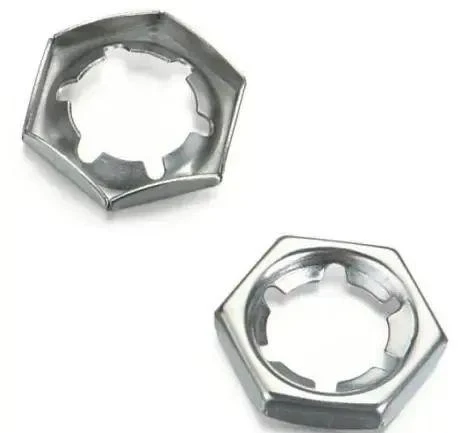
Cap nut
1. What is a cap nut?
As the name suggests, the cap nut is a hexagonal nut with a lid. The main function of the cap is to prevent the outer part of the lid from being fastened, so as to prevent moisture or some other corrosive substances from entering the inside and thus play the role of rust prevention, thereby improving the service time of itself and the connecting parts.
Different sizes of studs use different cap nut sizes, and longer studs use higher cap nuts. There are also self-locking cap nuts with twisted threads in the hexagonal area to form a tight friction fit to prevent the nut from loosening due to vibration.
2. Application scenarios
Cover nuts serve the same purpose as hexagonal nuts. Its characteristic is that the main nut is not easy to slide, but can only be tightened using a adjustable wrench, a dead wrench, a dual-purpose wrench (open part) or a special square hole socket wrench. It is mainly used for rough and simple parts, tires and front and rear axles in automobiles, tricycles, electric vehicles, etc., and can also be used to fix the road light frame base and some mechanical equipment that are often exposed to sunlight and rain.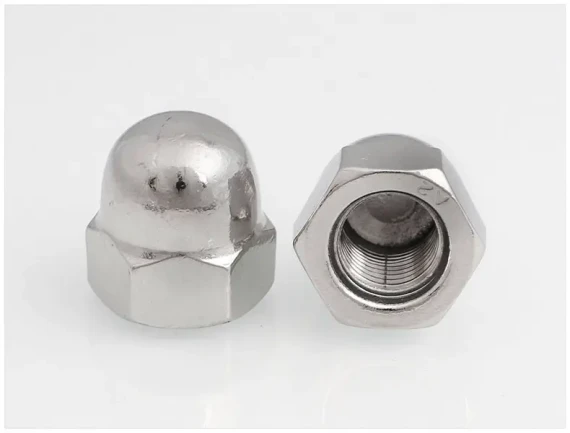
Nut knowledge
Apr 12, 2025
Leave a message
Next
Nut knowledgeSend Inquiry